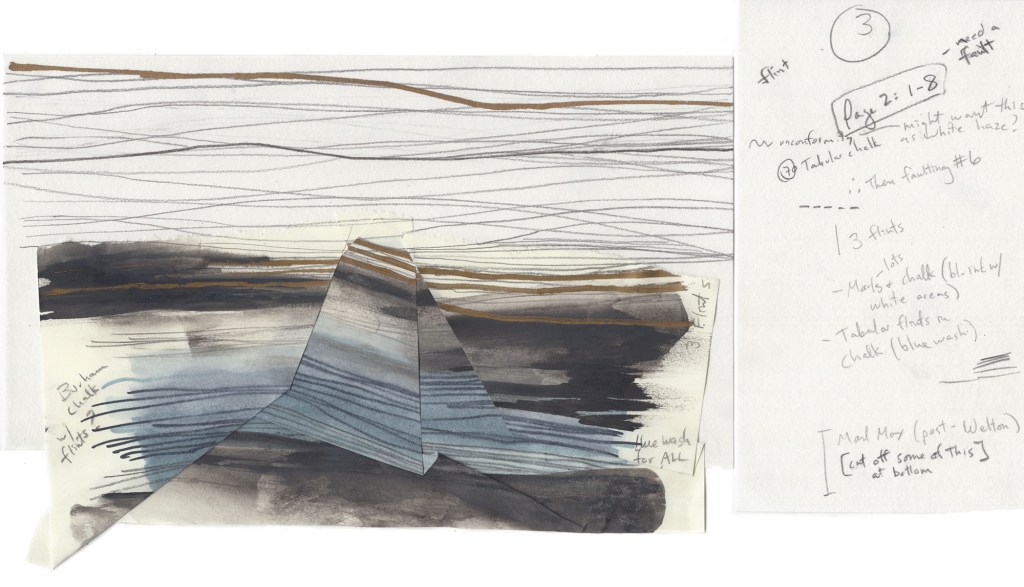
Since I’ve been working more on collages recently, I thought I’d reshare some of my collage work and videos to show how I use it to “draw”.

Collage is a medium I came to a bit later in my working years. It has evolved from my drawing and ink work when I was at a bit of a creative impass. So I used scraps of Chinese ink washes I’d made on mulberry paper, pieces of previous graphite drawing patterns, and even some watercolour swatches.
Collage became a way of building sketches, particularly of rock structures. Plus I could take line drawing that I’d used when considering stratigraphy, layers in the coastal cliffs, and abstract it by literally turning and flipping pieces of drawing.
The local limestone and sandstone here in Yorkshire settled in layers either at depth in the sea or as rivers settled them into the edges of their flow. Inbetween are mixed sandy limestones (or chalky sandstones!) that settled in the shallow waters along the shore. These foreshore layers are the ones that sometimes have caught the evidence of dinosaurs – footprints left when they compressed and broke the layers, then got filled in again with the next wave of sediment to build up on top of the surface. This process can be seen in my “Deep Time” project.


When I visited Cornwall on a residency, collage was my primary sketching method for painting ideas. The geology there was so entirely different to the sedimentary Jurassic geology of my Yorkshire coast. I needed to somehow build this solid jutting metamorphic rock that rose through the landscape, instead my familiar rock layers that build up by laying on top of each other slowly over time.
But serpentine in Cornwall? Serpentine is created by massive pressure and heat deep at the ocean floor, and through chemical change is lighter than the original ocean floor sediments. Over time it is moved to the surface through tectonic faults and spreading, since it’s formed near either ocean spreading ridges or near coastal fault lines. It’s an ancient rock. Jutting up through the landscape.

How to draw and paint this unfamiliar cohesive form? I’m used to patterns and sequences and in serpentine there are none.
I turned to collage for idea building. Here’s a video of the work I did on site:
And one of the finished paintings is the impressive “Emergence” (100x100cm on canvas) – my vision of a massive block standing proud against the blue sea, with golds and deep violet pinks from the serpentine softly emerging from the mist.


 TINA MAMMOSER